

A customer came to us convinced his transmission was failing. The car shuddered violently, lost power, and refused to pull the way it used to. Every symptom he described sits on the short list of classic transmission complaints, and he had already priced out a rebuild before he ever pulled into our parking lot. He was wrong, and it is a very good thing he found that out before he spent the money. His transmission was fine. His engine had coolant inside the cylinder head and a set of valves that were no longer serviceable. This article walks through that real case, keeps the customer and the vehicle anonymous, and teaches you the specific differences between poor engine performance and poor transmission performance so you can tell them apart before somebody sells you the wrong repair. If your car is shuddering, hesitating, or dropping into limp mode, schedule a free diagnosis with our technicians before you assume you know which system is at fault.
The Case That Started This Article
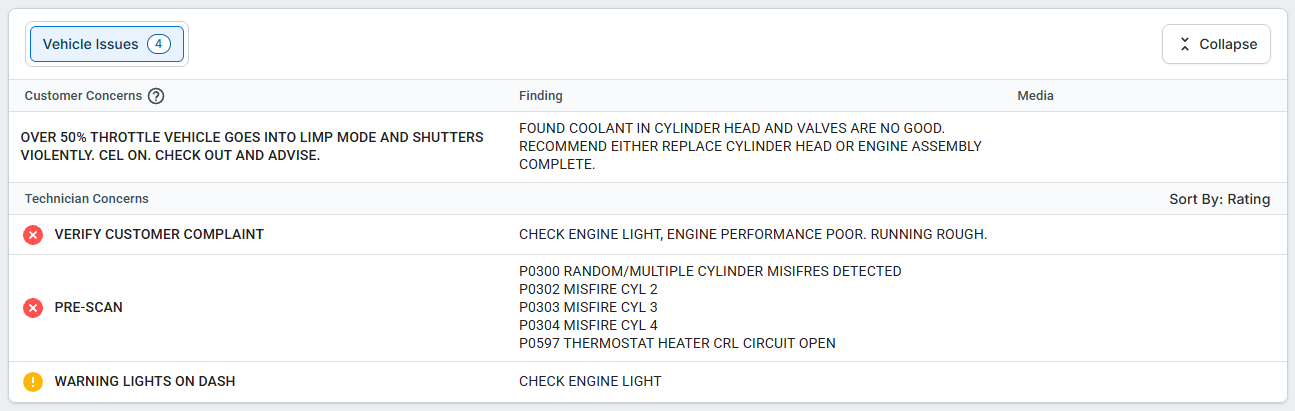
The complaint written on the repair order came straight from the customer, in his own words: over 50 percent throttle, the vehicle goes into limp mode and shudders violently, check engine light on, check out and advise.
Read that again, because the wording matters. The customer did not say "my engine is misfiring." He said the car shudders and loses power when he asks it to accelerate. That is the same sentence a person with a slipping transmission, a failing torque converter, or a worn clutch pack would write. Nothing in that complaint tells you which system is broken. It only tells you what the driver felt from the seat.
What the driver felt was real. The conclusion he drew from it was not.
Our technician started where every honest diagnosis starts: verify the customer complaint. He drove the vehicle and confirmed it himself. Check engine light on, engine performance poor, running rough. Then he pre-scanned the vehicle before touching a single part, and the scan told a very different story than "transmission."
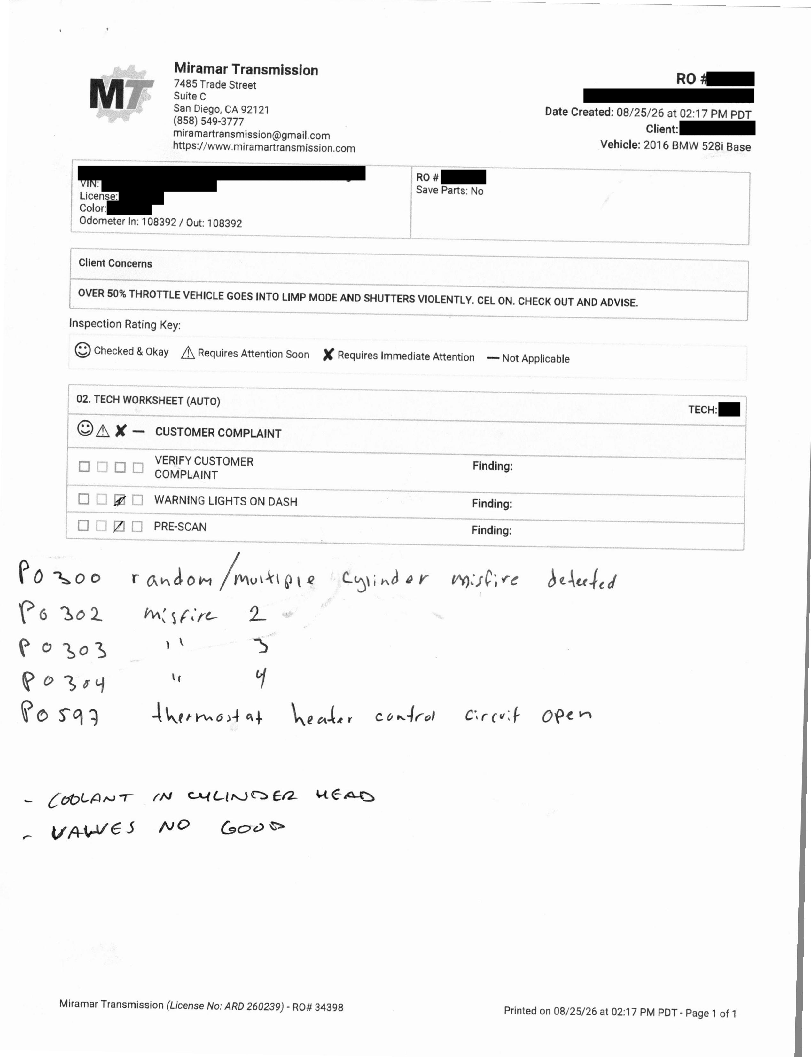
The stored codes were:
- P0300 - Random/multiple cylinder misfires detected
- P0302 - Misfire, cylinder 2
- P0303 - Misfire, cylinder 3
- P0304 - Misfire, cylinder 4
- P0597 - Thermostat heater control circuit open
Not one transmission code. No shift solenoid fault, no gear ratio error, no torque converter clutch circuit code, no transmission control module fault. Four misfire codes and a cooling system code.
Where that led, and why, is the whole lesson. But the finding was this: coolant was found inside the cylinder head, and the valves were no good. The recommendation was to replace the cylinder head or install a complete engine assembly. If that customer had walked into a shop that only sells transmissions, he could have paid for a full rebuild and driven away with the exact same shudder.
Why a Misfire Feels Exactly Like a Failing Transmission
This is the heart of the confusion, and almost nobody explains it to drivers.
Your transmission does not create power. It manages power. The engine makes torque, and the transmission decides how much of it reaches the wheels and at what ratio. From the driver's seat, you cannot feel which of those two jobs is failing. You only feel the result: the car is not delivering the power you asked for.
When cylinders stop firing cleanly, the engine stops producing smooth, continuous torque. Instead of a steady push, the driveline receives a series of uneven pulses. Those pulses travel through the flexplate, through the torque converter, through the transmission, and into the chassis. What reaches your seat is a shudder, a buck, or a violent shake.
That is precisely what a slipping transmission or a shuddering torque converter clutch feels like. Same location, same frequency range, same "the car is shaking and not pulling" sensation. The vibration that reaches you is not labeled. It does not announce its origin.
This is why misdiagnosis is so common, and why we covered it in Top 10 Misdiagnosed Auto Issues. A driver feels a shudder, searches the symptom online, finds a hundred pages about transmission failure, and arrives at a shop already certain of the answer.
What Limp Mode Actually Is, and Why Both Systems Can Trigger It
Limp mode is one of the most misunderstood terms in car ownership. It is not a transmission feature. It is a protective strategy, and more than one computer on your vehicle can invoke it.
Limp mode, also called failsafe or reduced power mode, is a control module deliberately restricting performance to prevent further damage. Depending on the vehicle and the fault, it can cap engine power, limit RPM, hold the transmission in a single gear, reduce or disable boost on a turbocharged engine, or all of the above at once.
Here is the part that trips people up. When an engine control module detects severe misfires, one of the most common protective actions is to cut power. On many vehicles it will also hold the transmission in a fixed gear so the driveline is not being shifted while the engine is running rough. The driver experiences a car that will not shift and will not accelerate.
The car did not shift because the engine told it not to. The transmission was following orders, not failing.
So when someone says "it went into limp mode, must be the transmission," there is no evidence behind that conclusion. Limp mode tells you a computer detected something serious. It does not tell you which system. That is what a scan tool is for. We cover dashboard warnings more broadly in Understanding Your Car's Warning Lights.
The Single Best Question to Ask Yourself: Does It Happen at a Load, or at a Shift?
If you remember nothing else from this article, remember this question. It separates engine problems from transmission problems better than any other clue a driver has access to.
Engine problems track with engine load and RPM. Transmission problems track with gear changes and vehicle speed.
Put concretely:
- If the shudder shows up whenever you push the throttle past a certain point, regardless of which gear you are in and regardless of whether the car just shifted, you are looking at an engine load problem.
- If the shudder shows up at the moment of a shift, or only in one specific gear, or only when the torque converter locks up around a particular speed, you are looking at a transmission problem.
In our case, the customer had already answered the question without realizing it. He said it happens over 50 percent throttle. He did not say it happens in third gear. He did not say it happens when it shifts. He tied the symptom to how hard he was pressing the pedal, which is another way of saying he tied it to engine load.
That is an engine complaint written in transmission language.
Symptom by Symptom: Engine or Transmission?
Here is a practical breakdown of the symptoms that get confused most often, and what each one actually points to.
1. Shuddering or Shaking Under Acceleration
Points to the engine when: it happens at a consistent throttle position or load level, it happens in every gear, it worsens going uphill or with a loaded vehicle, and the check engine light is on or flashing.
Points to the transmission when: it happens in a narrow speed band, typically under light throttle at cruise, and disappears if you accelerate harder or lift off. That specific pattern is a classic torque converter clutch shudder.
2. Loss of Power
Points to the engine when: RPM rises normally with the pedal but the car is slow, the exhaust note sounds uneven or popping, or the engine feels like it hits a wall at a certain throttle opening.
Points to the transmission when: RPM climbs high and fast without a matching increase in speed. That RPM-versus-speed disconnect is the signature of slipping, covered in How to Fix Slipping Gears in Your Transmission.
3. Hesitation When You Press the Gas
Points to the engine when: the hesitation is a stumble, a stagger, or a cough, and it can occur at steady speed with no shift happening. Fuel delivery problems live here too, which is why we wrote Common Causes of Low Fuel Pressure in Cars.
Points to the transmission when: there is a clean delay, a pause of a second or more, before the car engages and moves. That is an engagement delay, not a stumble. See How Transmission Problems Affect Your Car's Acceleration.
4. The Car Will Not Shift Out of One Gear
Points to the engine when: it began at the same time as a check engine light and rough running. This is almost always limp mode commanded by the engine computer.
Points to the transmission when: engine performance is completely normal, it idles smooth, it revs clean in neutral, and the only problem is that gear changes are not happening. See Troubleshooting a Non-Responsive Transmission.
5. Rough or Harsh Shifting
Points to the engine when: the roughness is present between shifts too. If the car is rough at a steady 45 mph with no shift occurring, the shift is not the problem.
Points to the transmission when: the car is perfectly smooth right up until the moment it changes gears, then bangs or jolts into the next one. Covered in Why is My Car Shifting Roughly?
6. Noises
Points to the engine when: the noise changes with RPM in neutral or park. If you can rev the engine sitting still and reproduce the noise, the transmission is not loaded and is unlikely to be the source.
Points to the transmission when: the noise only appears while the vehicle is moving, or changes between drive and neutral or between gears. Our full guide is Common Transmission Noises and Their Causes.
7. Fluid on the Ground
Points to the engine when: the fluid is amber to black and slick like motor oil, or green, orange, or pink and sweet-smelling, which is coolant. Read Why Is My Car Leaking Oil When Parked?
Points to the transmission when: the fluid is red or brown with a distinctly different feel and smell. See Why Is My Car Leaking Transmission Fluid? and Symptoms of Low Transmission Fluid.
8. Burning Smell
Points to the engine when: it smells like burning oil, or sweet like syrup, which indicates coolant burning off. A sweet smell is a serious warning of exactly the failure described in this case study.
Points to the transmission when: the smell is sharp and acrid, like overheated transmission fluid. Covered in What to Do If You Smell Burning from Your Transmission.
What the Scan Tool Found, and What Each Code Actually Means
A pre-scan is not a diagnosis. It is a starting point that tells the technician where to spend his time. Here is how a trained technician reads the five codes from this vehicle.
P0300: Random or Multiple Cylinder Misfires Detected
This code sets when the engine computer detects misfires that are not isolated to a single cylinder. The computer monitors tiny variations in crankshaft speed. Every power stroke gives the crank a small acceleration. When a cylinder fails to make its contribution, the crank momentarily slows, and the computer counts that as a misfire.
P0300 on its own is a broad code. It tells you multiple cylinders are misbehaving, which immediately makes single-component causes less likely. One bad ignition coil does not cause a random multiple misfire. Something shared across cylinders does: fuel pressure, air metering, compression, timing, or contamination in the combustion chambers.
P0302, P0303, P0304: Misfire on Cylinders 2, 3, and 4
This is where the diagnosis gets interesting, and it is the detail most people would overlook.
Three cylinders were flagged, and they were consecutive. Cylinder 1 was not. That pattern matters enormously.
Random component failures do not organize themselves neatly. If three coils failed at once, you would not expect them to be the three adjacent to each other. When misfires cluster in physically neighboring cylinders, a technician starts thinking about something structural and shared: a head gasket breach, a crack, a coolant passage, an intake leak, or a camshaft or timing problem affecting one region of the head.
Geography is evidence. Three neighboring cylinders misfiring is a map pointing at the cylinder head.
P0597: Thermostat Heater Control Circuit Open
This is the code an inexperienced tech dismisses as unrelated, and it is arguably the most important one in the list.
Many modern engines use a map-controlled thermostat with a small electric heater inside it. The engine computer energizes that heater to force the thermostat open earlier than coolant temperature alone would, giving it fine control over engine operating temperature. P0597 means the computer commanded that heater and detected an open circuit instead of the expected load.
By itself, P0597 is a cooling system electrical fault. It does not prove a head problem. But look at what you have on the screen: three neighboring cylinders misfiring, plus a cooling system fault, on the same vehicle, at the same time.
When misfires and cooling system faults appear together, an experienced technician adds one item to the top of the list that a parts-swapper never considers: coolant is getting somewhere it does not belong.
That is exactly what was found.
Why "Over 50 Percent Throttle" Was the Most Important Clue of All
The customer handed us a precision diagnostic detail and did not know it.
Small coolant intrusions can hide at light load. At idle and gentle cruise, cylinder pressures are low, the amount of coolant seeping in is small, and the engine can often burn through it without a noticeable stumble. The driver notices nothing, or writes it off as the car "feeling a little lazy."
Open the throttle past half, and everything changes:
- Cylinder pressure climbs sharply. Higher pressure differentials force more coolant past a compromised gasket, crack, or sealing surface.
- Combustion temperature and heat load rise. Cooling system pressure rises with it, pushing harder on any weak point.
- On a turbocharged engine, boost enters the picture. More air and fuel per cycle means higher peak pressures still.
- The fuel-and-air charge becomes harder to ignite. Coolant is not fuel. Liquid entering a combustion chamber absorbs heat, quenches the flame front, and interrupts combustion entirely.
The result is a misfire that appears only under load. And because the engine computer treats sustained heavy misfire as an emergency, it commands limp mode. Power is cut. The car shudders and refuses to pull.
A symptom that appears only above a specific throttle position is an engine load symptom. A transmission does not care how far down the pedal is, except insofar as it changes shift points. It cares about gear engagement, line pressure, and clutch holding capacity.
How Coolant Gets Inside a Cylinder Head
Your cylinder head is a dense casting containing three separate networks that must never meet: combustion chambers, oil galleries, and coolant passages. They run within a fraction of an inch of one another, sealed by the head gasket and by the integrity of the casting itself.
Coolant reaches a place it should not through a handful of routes:
1. Head Gasket Failure
The most common path. The gasket seals combustion pressure and separates coolant and oil passages. When a section fails, coolant enters the combustion chamber, combustion gases push into the cooling system, or coolant and oil mix. A breach between one coolant passage and two or three adjacent cylinders explains a clustered misfire pattern perfectly.
2. A Cracked Cylinder Head
Aluminum heads expand and contract with every heat cycle. Repeated overheating, or one severe overheating event, can crack the casting, often between valve seats where the metal is thinnest and hottest. A crack lets coolant weep directly into the chamber or the port.
3. A Warped Head or Deck Surface
Overheating can distort the head so it no longer sits flat. Even a perfect new gasket cannot seal an uneven surface, which is why a competent shop measures the head for flatness rather than simply bolting a gasket on and hoping.
4. Corrosion of Coolant Passages
Old or incorrect coolant loses its corrosion inhibitors and begins eating the metal it is supposed to protect. Over years this thins passage walls until they breach. This is the quiet, boring reason a coolant service interval matters far more than most owners believe.
5. Failed Ancillary Sealing Surfaces
Depending on engine design, coolant can also migrate through failed intake manifold gaskets, deteriorated coolant transfer seals, or a failed integrated oil cooler, and end up drawn into cylinders.
Note the common thread running through the top three: heat. Which is why a cooling system fault code sitting alongside misfire codes is never a coincidence worth ignoring.
Why the Valves Were Condemned Too
The finding was not only coolant in the head. It was coolant in the head and valves that were no good. Understanding why the valves went with it explains why the recommendation was a head or a complete engine rather than a gasket.
Coolant inside a running combustion chamber is destructive in several ways at once:
- It strips the protective deposit layer. Steam scours combustion chambers and valve faces clean, which sounds harmless and is not. It removes the thermal barrier those surfaces have operated with, changing how the valve sheds heat.
- It is not a lubricant. Valve stems, guides, and seats depend on a microscopic oil film. Coolant washes it away and accelerates wear at the guide and the seat.
- It causes localized thermal shock. Liquid hitting a valve at several hundred degrees creates rapid, uneven temperature swings that stress and distort the valve.
- It promotes corrosion and seat erosion. Coolant is chemically hostile to hot exhaust valve faces and seats over time, pitting the sealing surface.
- A valve that no longer seals makes the misfire permanent. Once the seat is eroded, the cylinder loses compression on every stroke. Fixing the coolant leak alone will not restore that cylinder.
This is why the repair scope grew. Sealing the coolant path is only half the job when the components exposed to it are already damaged. Recommending a cylinder head replacement or a complete engine assembly is not upselling. It is recognizing that the parts inside have already been consumed by the failure.
What Would Have Happened If We Had Assumed "Transmission"
Follow the alternate timeline, because this is the practical cost of a wrong assumption.
The customer arrives certain the transmission is failing. A shop that does not verify the complaint, or does not pre-scan, or is simply in the business of selling transmissions, accepts the customer's framing. The transmission is removed, rebuilt or replaced, and reinstalled.
Then the customer picks up the car, gets on the freeway, opens the throttle past half, and the car shudders violently and drops into limp mode. Exactly as before. Nothing changed, because nothing that was broken was touched.
Now the customer has:
- Paid for a major repair that fixed nothing.
- Lost weeks of vehicle availability.
- Still needs the engine repair, which was the actual problem.
- Continued driving a misfiring engine, which sends unburned fuel into the exhaust and can destroy a catalytic converter, adding a large repair that was entirely preventable.
- Lost all confidence in the shop, understandably.
Every bit of that is avoided by two steps that take a fraction of the time of the repair itself: verify the complaint, then scan before you sell anything.
The Diagnostic Process That Prevents a Wrong Repair
Here is the sequence a proper diagnosis follows, and what you should expect a good shop to do.
Step 1: Verify the Customer Complaint
The technician reproduces the symptom personally. Not a description, not an assumption. If a shop cannot tell you they confirmed the symptom themselves, they are working from a story rather than from evidence.
Step 2: Pre-Scan Before Touching Anything
Every module gets scanned, not just the engine. Codes are recorded exactly as found, along with freeze frame data showing the conditions present when the fault set. Pre-scan documentation is how you later prove what was wrong before any work was done.
Step 3: Read the Code Pattern, Not Just the Codes
Anyone can read a code. The skill is in what the combination means. Three adjacent cylinders plus a cooling fault is a pattern. Interpreting it is what separates diagnosis from parts replacement.
Step 4: Test to Confirm, Never Assume
Suspicion of coolant intrusion is confirmed with physical testing: cooling system pressure testing, combustion gas testing of the coolant, compression and cylinder leak-down testing, inspection of spark plugs for steam-cleaned surfaces, and visual inspection once the head comes off. A theory becomes a diagnosis only when a test confirms it.
Step 5: Scope the Repair to What Was Actually Found
Only after the failure is confirmed does the recommendation get written, and it covers everything the failure damaged rather than just the leak point.
Signs It Really Is Your Transmission
To be clear, transmissions absolutely do fail, and we rebuild them every week. These are the symptoms that genuinely point there:
- RPM flares upward without a corresponding increase in vehicle speed, especially during a shift.
- A delay of a second or more between selecting drive or reverse and the vehicle actually engaging.
- Harsh, banging shifts on an otherwise smooth-running engine.
- Shifting into the same wrong gear repeatedly, or hunting back and forth between two gears.
- Red or brown fluid on the driveway, or a burnt smell from the transmission fluid.
- Whining or humming that changes with vehicle speed rather than engine RPM.
- Stored transmission-specific trouble codes, such as gear ratio errors or shift solenoid faults.
- A shudder at light throttle in a narrow speed band that disappears under harder acceleration.
If those describe your vehicle, our guides on Top 10 Most Common Causes of Transmission Failure and Top 10 Signs Your Transmission Needs Repair are the right places to start, and Transmission Rebuild vs. Replacement explains the options.
Signs It Really Is Your Engine
These point toward the engine and away from the transmission:
- A flashing check engine light, which specifically indicates a misfire severe enough to damage the catalytic converter. Stop driving and get it looked at.
- Rough idle, or shaking that is present while parked in neutral.
- A symptom tied to throttle position rather than to gear changes.
- Popping, sputtering, or an uneven exhaust note.
- White exhaust smoke that persists after the engine warms up, or a sweet smell from the exhaust.
- Coolant level dropping with no visible external leak.
- Engine temperature climbing, or the temperature gauge behaving erratically.
- Bubbles in the coolant reservoir, or a reservoir that overflows shortly after shutdown.
- Milky, tan residue on the oil cap or dipstick, indicating coolant mixing with oil.
- A noticeable drop in fuel economy alongside poor power.
The last several on that list are the ones that would have caught this failure earlier. Coolant loss with no puddle underneath is one of the most under-reported serious symptoms in car ownership, because there is nothing to see. The coolant is not on the ground. It is going through the engine.
What You Can Check Yourself Before You Call a Shop
None of this requires tools, and all of it makes your diagnosis faster and more accurate.
- Note the exact conditions. Cold or warm? Which gear? What speed? What throttle position? Uphill or flat? During a shift or between shifts?
- Check whether it happens in neutral. Safely parked, rev the engine in park or neutral. If you can feel or hear the problem with the transmission unloaded, it is very unlikely to be the transmission.
- Look at your coolant reservoir when the engine is cold. Is the level below minimum? Has it dropped since you last looked? Never open a hot cooling system.
- Check your oil cap and dipstick. Milky or tan film means coolant and oil are mixing.
- Watch your exhaust on startup and after warm-up. Brief white vapor on a cold morning is normal condensation. Persistent white smoke after warm-up, especially with a sweet smell, is not.
- Note whether the check engine light is steady or flashing. Flashing means active, damaging misfire. Steady means a stored fault.
- Take a short video, with a passenger, if it is safe. A ten second clip of the dash and the sound is worth ten minutes of description.
What to Tell Your Shop So You Get an Accurate Diagnosis
Describe symptoms. Do not prescribe repairs.
The most expensive sentence a customer can say is "I need a transmission." It is expensive because a shop that takes it at face value has just been aimed away from the real problem by the person least equipped to make that call.
Compare these two:
- Prescribing: "My transmission is slipping, I need it rebuilt."
- Describing: "Above about half throttle the car shudders hard and loses power. The check engine light is on. It does it in every gear. It is fine driving gently."
The second version contains the actual diagnostic information: the load threshold, the gear independence, the warning light, and the conditions under which it does not occur. That is a technician's roadmap.
The customer in our case did exactly the right thing on his repair order. He described what the car did and asked us to check it out and advise. Whatever he believed on the drive over, what he put in writing was a symptom, and it left the diagnosis open.
The Real Cost of a Misdiagnosis
A wrong diagnosis does not simply waste the cost of one repair. It compounds:
- The wrong repair is paid for in full. Nobody refunds a rebuild you did not need.
- The real problem keeps progressing. A coolant leak into a cylinder never improves on its own. It gets worse, and it takes more of the engine with it.
- Secondary damage accumulates. Sustained misfire loads raw fuel into the exhaust and can destroy a catalytic converter, turning one repair into two.
- Weeks of vehicle downtime are lost twice.
- The decision window narrows. Caught early, a coolant intrusion may be a head gasket and machine work. Caught late, it is a complete engine assembly.
The single most cost-effective thing you can buy for a car with a mystery symptom is an accurate diagnosis, before any parts are ordered.
Frequently Confused: Torque Converter Shudder vs. Engine Misfire
These two get mixed up more than any other pair, so here is the clean distinction.
Torque converter clutch shudder typically feels like driving over rumble strips. It appears at light to moderate throttle in a narrow speed band, often somewhere between 35 and 50 mph, when the converter clutch is applying. It usually vanishes the moment you accelerate harder or lift off, because that releases the converter clutch. It is a transmission-side problem.
Engine misfire under load feels like a jerk, a buck, or a heavy stumble. It gets worse with more throttle, not better. It typically comes with a check engine light, and it does not care what gear you are in or what speed you are traveling.
One improves when you push harder. The other gets worse. That single test separates them from the driver's seat, and it is exactly the test our customer's own complaint had already run without him realizing it.
Conclusion
A shudder, a power loss, and a car that drops into limp mode are symptoms, not diagnoses. They describe what the driveline delivered to your seat. They do not identify which system failed to deliver it, and no amount of confidence in a guess changes that.
In this case the customer was certain the transmission was to blame, and every instinct he had was reasonable. But the codes pointed at three adjacent cylinders and the cooling system, the symptom tracked with throttle position rather than with shifts, and the actual failure was coolant inside the cylinder head with valves that could no longer seal. The transmission never had anything wrong with it.
That outcome came from a process, not from luck: verify the complaint, scan before selling, read the pattern rather than the individual codes, and confirm the theory with a physical test.
If your vehicle is shuddering, hesitating, losing power, or dropping into limp mode, do not assume you already know which system is at fault, and do not authorize a major repair for a system nobody has proven is broken. Get it diagnosed properly first. You can schedule a free diagnosis with our technicians, and we will tell you what your car is actually doing before anyone talks about what it needs.
Whether it turns out to be your engine or your transmission, the right repair starts with the right diagnosis.


.png)